Summary

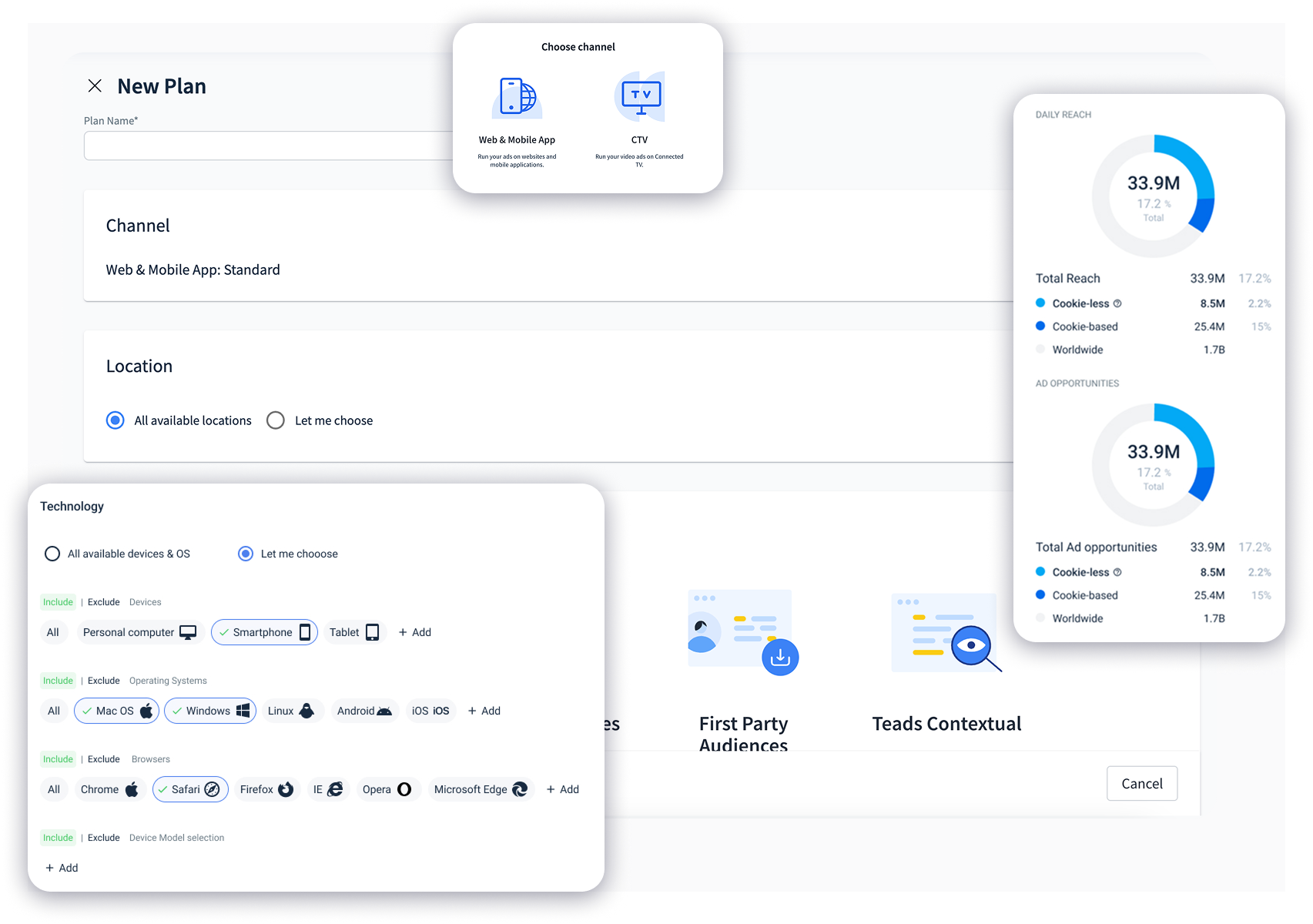
Targeting Planner gives advertisers direct control over their targeting data. They can build, combine and save audience plans and use them across campaigns. Behind it was Teads' cookie-less data strategy: first-party and cookie-less data that competitors couldn't match, made usable for every advertiser.

I was the sole designer, working with the data team's engineers and the PM, on what was probably the most data-heavy feature in Ad Manager.

  • Role

    Senior Product Designer, sole designer

  • Team

    1 Product Designer, 2 Engineers, 1 PM

  • Deliverables

    Research, dynamic form, visual reach model, saved plans

  • Impact

    One of several features that brought performance clients to Teads, as the performance business grew from 0% to nearly half of platform revenue

01 The problem:

Turning Data Infrastructure into Intuitive UI

Audience planning touched campaign setup, data infrastructure and reporting. The core design problem was to make cookie-less reach and data intersection logic approachable for someone without a data background, without dumbing any of it down for power users.

  1. Intersections were hard to understand without a visual model.
  2. Cookie-less reach, a real advantage, wasn't shown anywhere.
  3. Advertisers rebuilt the same audience combinations for every campaign.
  4. The scope crossed setup, data and reporting.

02 What I found

I reviewed Google Ads, Snapchat Ads and other platforms that work with first-party and third-party data, and audited our own internal tools.

  • Form fields that adapt to intent

    A dynamic form lowers cognitive load, because options change based on what the user selects.

  • Clear intersection and expanded audience

    Intersections need to feel visual and immediate, not abstract.

  • Cookie-less highlight

    Cookie-less reach belongs front and center. It was a real differentiator.

  • Unify planning with execution

    Plans must flow into campaign setup. Planning can't be a dead end.

03 The decision

Make the data visible, and keep plans connected

I worked with the PM and with data, engineering and account management teams to turn technical audience concepts into something a self-serve advertiser could use without training.

​

  1. A dynamic planning form that shows options in context.
  2. A visual model for audience intersections.
  3. A reach chart that splits cookie-based and cookie-less inventory.
  4. A saved plans library that flows into campaign setup, so nothing is entered twice.

04 Prototype

Visualizing logic, reach, and workflow continuity

Unusually for something this complex, the core structure held from the first iteration. Only the chart colors and illustration style changed afterwards.

High fidelity prototype

05 The outcome

From 0 to 45%: powering teads’ performance business

The performance business grew from 0% to nearly half of total platform revenue. Targeting Planner was one of several features built to bring performance clients to Teads, alongside Campaign Overview reworked for performance KPIs, Auction Report, Campaign Setup with the campaign objective and the Creative Editor. The new offering opened the platform to a category of advertiser who previously had no reason to use it.

05 Looking back

Discovery as a alignment tool

When stakeholders and users agree on the first pass, it usually means the problem was understood before any screens existed. The upfront discovery did that job here.

Got a complex product that needs structure? Let's talk.

Summary

Targeting Planner gives advertisers direct control over their targeting data. They can build, combine and save audience plans and use them across campaigns. Behind it was Teads' cookie-less data strategy: first-party and cookie-less data that competitors couldn't match, made usable for every advertiser.

I was the sole designer, working with the data team's engineers and the PM, on what was probably the most data-heavy feature in Ad Manager.

  • Role

    Senior Product Designer, sole designer

  • Team

    1 Product Designer, 2 Engineers, 1 PM

  • Deliverables

    Research, dynamic form, visual reach model, saved plans

  • Impact

    One of several features that brought performance clients to Teads, as the performance business grew from 0% to nearly half of platform revenue

01 The problem:

Turning Data Infrastructure into Intuitive UI

Audience planning touched campaign setup, data infrastructure and reporting. The core design problem was to make cookie-less reach and data intersection logic approachable for someone without a data background, without dumbing any of it down for power users.

  1. Intersections were hard to understand without a visual model.
  2. Cookie-less reach, a real advantage, wasn't shown anywhere.
  3. Advertisers rebuilt the same audience combinations for every campaign.
  4. The scope crossed setup, data and reporting.

02 What I found

I reviewed Google Ads, Snapchat Ads and other platforms that work with first-party and third-party data, and audited our own internal tools.

  • Form fields that adapt to intent

    A dynamic form lowers cognitive load, because options change based on what the user selects.

  • Clear intersection and expanded audience

    Intersections need to feel visual and immediate, not abstract.

  • Highlight cookie-less

    Cookie-less reach belongs front and center. It was a real differentiator.

  • Unify planning with execution

    Plans must flow into campaign setup. Planning can't be a dead end.

03 The decision

Make the data visible, and keep plans connected

I worked with the PM and with data, engineering and account management teams to turn technical audience concepts into something a self-serve advertiser could use without training.

​

  1. A dynamic planning form that shows options in context.
  2. A visual model for audience intersections.
  3. A reach chart that splits cookie-based and cookie-less inventory.
  4. A saved plans library that flows into campaign setup, so nothing is entered twice.

04 Prototype

Visualizing logic, reach, and workflow continuity

Unusually for something this complex, the core structure held from the first iteration. Only the chart colors and illustration style changed afterwards.

High fidelity prototype

05 The outcome

From 0 to 45%: powering teads’ performance business

The performance business grew from 0% to nearly half of total platform revenue. Targeting Planner was one of several features built to bring performance clients to Teads, alongside Campaign Overview reworked for performance KPIs, Auction Report, Campaign Setup with the campaign objective and the Creative Editor. The new offering opened the platform to a category of advertiser who previously had no reason to use it.

05 Looking back

Discovery as a alignment tool

When stakeholders and users agree on the first pass, it usually means the problem was understood before any screens existed. The upfront discovery did that job here.

Got a complex product that needs structure? Let's talk.